Helping businesses save money can be a profitable business itself, especially in tough times. Just ask Offsite Data Depot.
The
Carson City-based records storage and information management solutions
provider is on track to double its revenue this year and plans to expand
into a second facility in Reno and add several more employees to its
four-person staff.
The company offers document shredding,
document scanning, online backup and email filtering. But the bulk of
its work is in storing records for business, government agencies, even
individuals, using barcode technology to track stored records and give
customers quick access to them.
“Typically, every business has to
keep records for compliance and regulation, but they don’t have space
internally,” says Gerd Poppinga, director of operations at Offsite.
“We’re cheaper than other options of storage. We can store for merely
pennies as opposed to dollars. Back when things were hunky-dory,
businesses used to do everything themselves and now they’re realizing it
can be more efficient and cut costs to have us do it.”
Most of
Offsite’s customers, such as the Nevada Supreme Court and CPA firm
Casey, Neilon & Associates, are located near Offsite’s
30,000-square-foot warehouse in the state capital.
But Offsite is
signing up more customers in Reno, including the Atlantis Casino Resort
Spa, which says Offsite is saving the company $6,000 a month in storage
costs.
So Offsite has its eye on adding about 100,000 square
feet of warehouse space in Reno in a newer, concrete or steel fire-safe
facility with docks and climate-control vaults designed for document and
media storage. At the same time, says Poppinga, the company will need
to add general office staff, warehouse personnel and document scanning
workers since the scanning side of the business is picking up.
Offsite
also hopes to broaden its customer base to include individuals and
organizations with sophisticated storage needs. The company, for
example, is now talking to the Washoe Tribe in Reno about storing some
of its artifacts.
“Lots of people think of safety deposit box in a bank,” says Poppinga.
“But that limits them to bank hours. With us, they have access 24 by 7.”
By ,
11/12/2012 NNBW

Offsite Data Depot offers complete records storage and information management services for businesses located in northern Nevada and surrounding communities. By providing a full range of records storage and management services to businesses, government entities, nonprofit organizations, and other organizations of all types and sizes, Offsite enables its customers to save money and secure their most vital information.
Showing posts with label files. Show all posts
Showing posts with label files. Show all posts
Wednesday, November 14, 2012

Friday, April 13, 2012
Best Practices for Disaster Preparedness
Offsite Data Depot, a leader in document storage, secure document destruction, digital document management and data protection, shares best practices for disaster preparedness and records information management. With the recent and early occurrence of tornadoes nationwide and expected disruption to businesses, Offsite offers a six-step process to assist companies of all sizes to better protect documents and critical data. Offsite is a leader in managing critical records for businesses in and around northern Nevada.

Disasters typically leave organizations little or no time to secure documents, so it is mission critical to create a RIM (records information management) plan and integrate strategies that proactively enforce it. Fires, wind storms, floods and earthquakes are enemies of physical documents. Even a frozen water pipe is a potential disaster from a document security standpoint. Offsite encourages businesses to create, practice and enforce a disaster preparedness plan in advance to maintain the integrity of critical documents and maintain compliance.
Through more than a decade of experience securing critical business documents for organizations, Offsite developed a straightforward set of best practices to safeguard against even the most extreme disasters and minimize the risk of service discontinuation. Offsite recommends that businesses initiate the following strategies before a natural disaster strikes:
- Collect and store critical documents and computer backup tapes in a secure off-site location. If a secure off-site location is not available, create an infrastructure that will best protect documents on-site from natural elements and unauthorized personnel.
- Create and communicate a RIM plan, detailing the past and current life-cycle status of documents needed to support critical business functions and locations across all departments and functional areas.
- Identify the organizational/functional areas that play a part in the secure document life-cycle in times of emergency, such as critical departments, procedures, resources, vendors and alternate sources for supplies.
- Perform full risk assessments of physical security of critical documents, facility safety and personnel accessing original documents.
- Conduct annual document audits and disaster retrieval reenactments
- Consult a local records management company for services and information on how to get started.
Additionally, lost or damaged documents can place organizations outside of strict compliance regulations, such as HIPAA, HITECH, FACTA and Sarbanes-Oxley, which require the retention of volumes of records.
Whether files are stored on-site or off-site, and regardless of format, all departments must clearly know what records are most important, where they are retained and how to access them. An implemented, clearly communicated and strictly enforced strategy will greatly strengthen the facilitation of business continuity during times of emergency.
Wednesday, February 15, 2012
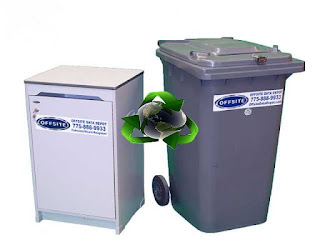
Secure Document Shredding of On-Site or Off-Site Materials
|
Tuesday, June 21, 2011
Offsite Data Depot Offers Complete Records Management
Offsite Record Storage & Management:
Our modern, specifically-designed record management facility is located within minutes of downtown Carson City, Nevada. We can free up valuable office space (space that can be used for income-producing activity) and give you quick access to your records, giving you confidence that your documents are safe and secure.
Our 30,000-square-foot facility is surrounded by a commercial area. The building is made up of concrete tilt up walls that are fire protected and access controlled to ensure that only those with proper authorization examine or remove a company’s records. We also monitor security via 24 hour surveillance system. Offsite also picks up and delivers records at the customer’s request. The records inventory is indexed on a computer system that uses a state of the art bar-coding process to identify individual boxes, or, if necessary, specific records within a box. Offsite also sells storage supplies, including special boxes for medical x-rays, and offers certified records destruction.
Document storage services include:
· reference and re-filing at the document, file, or carton level
· 24/7 access, after hours available upon demand
· fax, photocopy, and image on demand
· pick up and delivery on a scheduled, rush, or disaster response level
· specially-constructed, fireproof and environmentally-controlled facilities
· we also provide a private area in which you can examine your records in a clean and quiet atmosphere.
· reference and re-filing at the document, file, or carton level
· 24/7 access, after hours available upon demand
· fax, photocopy, and image on demand
· pick up and delivery on a scheduled, rush, or disaster response level
· specially-constructed, fireproof and environmentally-controlled facilities
· we also provide a private area in which you can examine your records in a clean and quiet atmosphere.
Climate-Controlled Vault Storage:
Many companies are unaware of the existence of off-site storage facilities for their backup computer data and invest hundreds or thousands of dollars in "fireproof" file cabinets or safes. Many times the investment is also perceived as a cost-saving measure because companies are unaware of the economics of proper, professional off-site storage.
· Offsites’ climate controlled vault is designed to ensure the safety and security of all types of media.
· The temperature and humidity are maintained and monitored by its independent HVAC system.
· The vault is protected with a waterless fire suppression system
· All security and fire detection systems are monitored 24 hours a day.
· Access is strictly limited to Offsites’ trained & screened personnel.
Offsites' vault is designed to handle many types of media, including:
Vital Records, Data Storage Tapes including 4mm, 8mm, DLT, Optical Disks, CDROM, CD-R, Audio Tapes, Video Tapes, Microfiche, Microfilm, & any other type of Confidential Records. We even store paintings and other personal items.
Email Filtering & Spam Control:
Unique Spam Filtering Technology –
We do not use unreliable heuristics, DNS blacklists, or Bayesian filters to identify spam. Instead, we investigate mass mailings, applying uniform standards before crafting the precise rules that block just the spam, not your important business communications. We feel that manual examination is the only effective way to beat spammers at their own game. When spammers adopt a new technique, we rapidly adapt.
Unsurpassed Ease-of-Use –
So simple to use that training is not necessary. There's nothing to install; no changes to your client machines. Our Web Dashboard consolidates all your capabilities online, whether you are an account administrator, domain administrator, or just a regular email user.
Guaranteed Delivery –
If your mail server goes down, our servers will store inbound email for up to four days. When your server comes back online, email is released in an orderly fashion to prevent overloading your server.
Guaranteed Results –
We guarantee that Offsite will virtually eliminate all unwanted email, increase productivity and dramatically reduce the risk associated with virus carrying spam and objectionable material. If you are unhappy for any reason, simply notify us by phone or email within 30 days and your subscription will be canceled and you pay nothing.
Affordable Solution –
Offsite spam and virus protection is less than $30 per mailbox per year, with volume discounts starting at just 50 mailboxes. We offer a 30 day trial period and you will start seeing immediate results.
· No minimums
· No contracts
· Nothing to install
· No equipment to buy
· No setup charges
· 30-day risk free trial
Online Cloud Storage & Backup:
Reliability –
With Offsite backups, you can always rest assured that your data is secure - even if your premises have been compromised due to disaster, theft, or system crash. We maintain state-of the-art servers in a secure, offsite location. Our security system utilizes the finest technology available today with AES256 encryption, which is better than most national banks and government agencies.
Cost Effective –
Offsite cloud backup is by far a more cost effective backup system than maintaining your own onsite backup. If your system is damaged, or goes down:
· There is no need to buy replacement equipment
· No additional personnel or time is required to recover your data
· Cost of tapes is eliminated & downtime is minimal
We offer a risk free trial period for 15 days, and for each and every backup there are detailed reports that can be emailed as needed. The backups are managed and monitored with immediate customer support. The best part of all is that it is user-friendly and very simple to restore files you need immediately.
Document Scanning & Imaging:
Electronic documents are no different. A document imaging system should provide several different methods of organizing information for future use. This is why we use industry specific software which is indeed the "state of the art" in electronic document management. Each file can be accessed within seconds by typing in any key word or phrase that a company would already use to manually look up a file, thus making your workforce more time efficient and productive.
Document imaging will –
· Enable you to manage millions of paper files and retrieve the one you need in a matter of seconds
· Easy to use, whether you are the individual that uses the files, the records manager, or IT manager
· Let you share documents with other employees while protecting confidential information
· Allow you to email, fax, or securely look online with the click of a mouse
· Provide an easier way to share documents with other offices or take them on the road when necessary
· Conform to the manner in which you work rather than force you to change your current tasks
Secure online retrieval –
Offsite’s web repository allows organizations to better manage their paper documents by enabling them to store and access them electronically. This approach has significant advantages over filing in a traditional metal file cabinet, such as: maximized office space, cost savings as a result of a reduction in paper copies made, and disaster recovery benefits since files are backed up electronically and hosted on Offsite Data Depot's secure server.
Document & Media Destruction:
By properly shredding all private and confidential information, you can diminish the chances that identity theft and fraud will affect yourself and your customers, employees and stockholders. Because of the proliferation of fraud and identity theft, the government has enacted a series of laws designed to enforce the protection of private information. Paper shredding is now a part of good corporate citizenship. Now, rules such as the following mandate document shredding. In many cases, state governments have even more encompassing laws.
You save money by using a professional document shredding company because:
· You don't have to pay your employees to shred the paper
· You don't have to purchase and maintain your own shredding equipment
· You don't have to remove paper clips and staples
· You don't have to clean up the dust from shredding
· You don't have to pay for the cost of disposal of the paper
Contact Info:
Mailing Address:
P.O. Box 21406
Carson City, NV. 89721
Records Center:
550 Mallory Way
Carson City, NV. 89701
Bus: 775-888-9933
Fax: 775-888-9180
www.offsitedatadepot.com

Professional Records Management
DUNS # 802843073
CCR, ORCA Registered/Small Business
NAICS codes:493110, 493190, 518210, 541519, 541611, 541618
The best way to protect your vital business information is to keep it "Offsite"
Tuesday, May 24, 2011
Intelligent imaging: A hybrid approach to digital, paper
Company executives faced with the responsibility of information management often have difficulty deciding whether to implement paper and/or digital archiving methods. Why choose one method over the other? What are the cost and retrieval benefits of each?
Financial, legal and medical businesses, for example, have large volumes of physical records, and want very much to convert to digital archiving. Where to start?
Many executives, quite frankly, are overly enamored with the vision of life in the digital storage world. The path from today’s pain to tomorrow’s utopia is not always a smooth one. Rarely do you find information stored in only one central building. Today’s business information is found in multiple formats and locations: electronic files, email archives, file cabinets and record storage boxes. And keep in mind that today’s legal rules and regulatory mandates play a role in managing this diverse records environment. As a result, businesses must innovate to effectively manage their document and record assets to achieve business efficiency, enhance customer service and maintain regulatory compliance.
There are strong advocates for both paper and digital solutions. The best solution for your business likely exists somewhere in the middle. Between maintaining the paper “status quo” or “imaging everything” are attractive options that leverage the cost-effectiveness of physical storage with the convenience of digital imaging.
These include:
• Image on demand: Store records and scan them as they are requested.
• Selective scanning: Scan records with a high likelihood of retrieval or access.
• Abstract scanning: Scan a small subset of high-value images within a larger record; not all records need to be captured within each document.
Physical vs. digital: which is cheaper? Here is our attempt to provide directional price guidance with a “what-if” cost analysis.
Assume that your hard-copy documents will be stored in standard record storage boxes. Each storage box holds approximately 2,000 pages (2,500 images) of business documents. Eight storage boxes will contain the equivalent of 20,000 digital images or approximately 1GB of digital storage. Storage costs for one box will average $5 per year, including a low level of file retrievals.
At prevailing conversion rates, it will cost between $200 and $300 to convert the documents in one box to digital images. Therefore, the cost of digital conversion is equivalent to the cost of retaining the documents in paper form for a period of 40 to 60 years. Adding the costs of a digital storage and retrieval solution to the costs of conversion often creates a significant financial barrier to implementing a full digital-conversion project. Under most conditions, physical archival storage is a cheaper alternative than digital storage when the cost of conversion is included.
A compelling business-value proposition may justify digital storage over physical storage, but as you can see in the example above, physical storage is the more cost-efficient alternative.
Many local organizations such as Northern Nevada Title Co., Lumos & Associates, Greater Nevada Credit Union, Sierra Surgical and CGI save between 40 percent to 60 percent by storing and using intelligent imaging solutions to become more efficient in their day-to-day operations. The ultimate goal for these companies is to streamline access to records, provide a higher level of customer service for clients, and save money.
Jenny Casselman, loan servicing manager at Greater Nevada Mortgage Services in Carson City, confirms the advantages of the hybrid approach for GNCU. “Our mortgage division retains physical loan document files for an appropriate length of time, but we also want to safely and securely dispose of the historical files in a timely manner. We scan and convert documents to electronic files to save on storage costs and to gain quicker access when needed,” she says.
If your organization is looking for effective hybrid record strategies, you may find your best option combines cost-effective physical storage with digital conversion of selected high-value documents. These records can be identified, scanned and stored in a digital repository that provides easy and secure access. Your highest-value solution is frequently structured around this type of intelligent scanning. If you are not sure where to start then use this rule of thumb: Scan only what you need, only when you need it.
According to AIIM Market Intelligence research, paper consumption and photocopying is still on the rise in 27 percent of organizations. However in 39 percent of companies, it is finally starting to fall. Among organizations with more extensive, mature scanning and capture operations, 53 percent are seeing a reduction in paper usage.
Gerd Poppinga and Brian Olson are managing partners of Offsite Data Depot in Carson City, a company that provides digital and paper records storage and information management services. Contact them at 775-888-9933 or email: sales@offsitedatadepot.com
Financial, legal and medical businesses, for example, have large volumes of physical records, and want very much to convert to digital archiving. Where to start?
Many executives, quite frankly, are overly enamored with the vision of life in the digital storage world. The path from today’s pain to tomorrow’s utopia is not always a smooth one. Rarely do you find information stored in only one central building. Today’s business information is found in multiple formats and locations: electronic files, email archives, file cabinets and record storage boxes. And keep in mind that today’s legal rules and regulatory mandates play a role in managing this diverse records environment. As a result, businesses must innovate to effectively manage their document and record assets to achieve business efficiency, enhance customer service and maintain regulatory compliance.
There are strong advocates for both paper and digital solutions. The best solution for your business likely exists somewhere in the middle. Between maintaining the paper “status quo” or “imaging everything” are attractive options that leverage the cost-effectiveness of physical storage with the convenience of digital imaging.
These include:
• Image on demand: Store records and scan them as they are requested.
• Selective scanning: Scan records with a high likelihood of retrieval or access.
• Abstract scanning: Scan a small subset of high-value images within a larger record; not all records need to be captured within each document.
Physical vs. digital: which is cheaper? Here is our attempt to provide directional price guidance with a “what-if” cost analysis.
Assume that your hard-copy documents will be stored in standard record storage boxes. Each storage box holds approximately 2,000 pages (2,500 images) of business documents. Eight storage boxes will contain the equivalent of 20,000 digital images or approximately 1GB of digital storage. Storage costs for one box will average $5 per year, including a low level of file retrievals.
At prevailing conversion rates, it will cost between $200 and $300 to convert the documents in one box to digital images. Therefore, the cost of digital conversion is equivalent to the cost of retaining the documents in paper form for a period of 40 to 60 years. Adding the costs of a digital storage and retrieval solution to the costs of conversion often creates a significant financial barrier to implementing a full digital-conversion project. Under most conditions, physical archival storage is a cheaper alternative than digital storage when the cost of conversion is included.
A compelling business-value proposition may justify digital storage over physical storage, but as you can see in the example above, physical storage is the more cost-efficient alternative.
Many local organizations such as Northern Nevada Title Co., Lumos & Associates, Greater Nevada Credit Union, Sierra Surgical and CGI save between 40 percent to 60 percent by storing and using intelligent imaging solutions to become more efficient in their day-to-day operations. The ultimate goal for these companies is to streamline access to records, provide a higher level of customer service for clients, and save money.
Jenny Casselman, loan servicing manager at Greater Nevada Mortgage Services in Carson City, confirms the advantages of the hybrid approach for GNCU. “Our mortgage division retains physical loan document files for an appropriate length of time, but we also want to safely and securely dispose of the historical files in a timely manner. We scan and convert documents to electronic files to save on storage costs and to gain quicker access when needed,” she says.
If your organization is looking for effective hybrid record strategies, you may find your best option combines cost-effective physical storage with digital conversion of selected high-value documents. These records can be identified, scanned and stored in a digital repository that provides easy and secure access. Your highest-value solution is frequently structured around this type of intelligent scanning. If you are not sure where to start then use this rule of thumb: Scan only what you need, only when you need it.
According to AIIM Market Intelligence research, paper consumption and photocopying is still on the rise in 27 percent of organizations. However in 39 percent of companies, it is finally starting to fall. Among organizations with more extensive, mature scanning and capture operations, 53 percent are seeing a reduction in paper usage.
Gerd Poppinga and Brian Olson are managing partners of Offsite Data Depot in Carson City, a company that provides digital and paper records storage and information management services. Contact them at 775-888-9933 or email: sales@offsitedatadepot.com
Tuesday, March 29, 2011
Off-site tape vaulting is an essential part of any disaster recovery plan
 The key reason we back up data is to ensure that an organization has copies of essential data in case of a disaster. With that in mind, it's time to look at off-site tape vaulting, which is the secure storage of backup tapes away from your primary IT infrastructure. This brings up two questions: How far off-site should I vault tapes? How often should they be moved there?
Dealing with the last question first, the question of how often to vault tapes is dictated by your recovery point objective. If the minimum amount of data you can realistically stand to lose is 24 hours' worth, then you should vault backup tapes every 24 hours.
The big mistake many small and medium size enterprises fall into here is to not send a tape off-site until it's full because it may seem like a waste of tape capacity or they have pricing concerns. While saving a few pounds on tapes may seem worthwhile, if a tape you've taken days to fill is destroyed in a fire, you'll lose far more than the tape. So, you should buy more tapes and send them off-site as often as your recovery point requires. Another reason we may avoid off-site tape vaulting is because we want to keep tapes on-site so data is accessible in case of erroneous deletion by a user, or there's a file corruption issue and we need to restore from the original tape. But don't let this be a reason to not send tapes off-site. The answer is to make two copies: retaining one copy for a fast file restore (if needed) and sending the other off-site.
 As to where and how far off-site you should vault tapes, this will vary according to the likely threat your business faces. Fire could destroy an office building, so moving tapes to another floor would be inadequate protection. Moving tapes to a nearby office may also prove useless if both locations are in a flooding or known earthquake zone. Keeping tapes or thumb drives in a car has its obvious disadvantages. Therefore, having an up-to-date disaster recovery strategy that deals with the issue of data backup and off-site vaulting is critical.
The conditions in which tapes are vaulted is also important. Tapes should be handled according to manufacturer recommendations in terms of temperature and humidity. To ignore this could result in a loss of data or reduced tape life.
 One way of dealing with issues arising from the need to store tapes off-site in an optimal fashion is to engage a tape vaulting services company. This type of service provides collection of tapes, storage in temperature and humidity controlled premises, as well as insurance against loss or damage to media. Another option is electronic vaulting, a term that encompasses nearly any method of backing up data over a network to a remote location also known as cloud storage, today.
 Friday, March 25, 2011
The Intelligent Archive-Going Beyond Intelligent Capture
Regardless of your industry of focus, you are sure to have heard the word archive. But what does archive
really mean? And does it mean the same thing to you as it does to the person in the next office? Is an
archive just a repository where documents are stored never to be found again? Or is an archive something
that can actually provide a benefit, or even better, a measurable ROI?
Because of the high demand for timely record retrieval, organizations both large and small need to look to a
content management system that will enable them to securely and accurately store their records with as
much information as possible so that the documents can be recalled quickly, creating an intelligent archive.
This involves utilizing technology that can locate and recognize varying writing styles or mixed documenttypes
and layouts so that once digital, the information can be searched, with keywords or phrases identified
for fast retrieval.
Considering that documents are being imaged, how do you then make the documents intelligent meaning
searchable and reportable and the archive a beneficial tool for the organization? Data capture and routing
is critical, although not an easy feat for most recognition technologies and something that requires advanced
capabilities beyond simple rules-based classification or common OCR or ICR.
Great strides have been made in the ability to automatically locate, extract, search, and index data from
electronic documents including those of an unstructured format. Technology now allows digitized documents
to be analyzed and indexed on a holistic or transaction level in relation to one another, as well as by their
geometric layout and content characteristics. The documents can then be searched for pre-defined elements
or keywords and, in addition to being archived, the results may be incorporated into pre-existing discovery,
redaction, declassification, or document management systems thus providing unparalleled access to the
information. Users maintain privacy and adhere to compliance regulations, as complex and handwritten
significant difference in the efficiency of the tasks that were previously performed by hand, by allowing the
processes to become automated from initial capture through to archive. documents are no longer a bottleneck
requiring manual processing. Advanced technologies make a
Many still believe that unstructured or complex documents can only be keyed and, given the demands of
today’s market, any automated solution must be at least as error-free as the manual processes it replaces.
However, accuracy is equally as important as successful discovery, due diligence, compliance, and
declassification features found in today’s more advanced recognition and classification engines.
Additionally, those looking to implement such an archiving solution must also examine the definition of and
metrics around success. The question should not only be, “What is the read rate?” but also, “How much can
be automated, how much time can be saved, how much manual labor can be eliminated, and how robust
and comprehensive of a database can be built for search?” The ROI produced for organizations adopting this
technology is not only seen in terms of a savings on their bottom line, but also in terms of the time saved
through newly realized efficiencies. And once scanned, complex data that was automatically located and
extracted can be entered into the IT system and more quickly distributed to those that need it, as well as
indexed for archive and retrieval based on complex queries within the newly built database. This increase in
accessible and search-able information from a central repository not only speeds knowledge distribution, but
it elevates the organization’s global intelligence.
With new regulations and the continued movement towards the paperless office, organizations must consider
more than just how to get their documents into electronic format, but what they will do once these documents
are scanned. By utilizing the right tools for capturing all data and indexing all documents, an archive can
easily make the transition to intelligent archive.
By Wendi Klein, director of marketing & communications, North America, A2iA
really mean? And does it mean the same thing to you as it does to the person in the next office? Is an
archive just a repository where documents are stored never to be found again? Or is an archive something
that can actually provide a benefit, or even better, a measurable ROI?
Because of the high demand for timely record retrieval, organizations both large and small need to look to a
content management system that will enable them to securely and accurately store their records with as
much information as possible so that the documents can be recalled quickly, creating an intelligent archive.
This involves utilizing technology that can locate and recognize varying writing styles or mixed documenttypes
and layouts so that once digital, the information can be searched, with keywords or phrases identified
for fast retrieval.
Considering that documents are being imaged, how do you then make the documents intelligent meaning
searchable and reportable and the archive a beneficial tool for the organization? Data capture and routing
is critical, although not an easy feat for most recognition technologies and something that requires advanced
capabilities beyond simple rules-based classification or common OCR or ICR.
Great strides have been made in the ability to automatically locate, extract, search, and index data from
electronic documents including those of an unstructured format. Technology now allows digitized documents
to be analyzed and indexed on a holistic or transaction level in relation to one another, as well as by their
geometric layout and content characteristics. The documents can then be searched for pre-defined elements
or keywords and, in addition to being archived, the results may be incorporated into pre-existing discovery,
redaction, declassification, or document management systems thus providing unparalleled access to the
information. Users maintain privacy and adhere to compliance regulations, as complex and handwritten
significant difference in the efficiency of the tasks that were previously performed by hand, by allowing the
processes to become automated from initial capture through to archive. documents are no longer a bottleneck
requiring manual processing. Advanced technologies make a
Many still believe that unstructured or complex documents can only be keyed and, given the demands of
today’s market, any automated solution must be at least as error-free as the manual processes it replaces.
However, accuracy is equally as important as successful discovery, due diligence, compliance, and
declassification features found in today’s more advanced recognition and classification engines.
Additionally, those looking to implement such an archiving solution must also examine the definition of and
metrics around success. The question should not only be, “What is the read rate?” but also, “How much can
be automated, how much time can be saved, how much manual labor can be eliminated, and how robust
and comprehensive of a database can be built for search?” The ROI produced for organizations adopting this
technology is not only seen in terms of a savings on their bottom line, but also in terms of the time saved
through newly realized efficiencies. And once scanned, complex data that was automatically located and
extracted can be entered into the IT system and more quickly distributed to those that need it, as well as
indexed for archive and retrieval based on complex queries within the newly built database. This increase in
accessible and search-able information from a central repository not only speeds knowledge distribution, but
it elevates the organization’s global intelligence.
With new regulations and the continued movement towards the paperless office, organizations must consider
more than just how to get their documents into electronic format, but what they will do once these documents
are scanned. By utilizing the right tools for capturing all data and indexing all documents, an archive can
easily make the transition to intelligent archive.
By Wendi Klein, director of marketing & communications, North America, A2iA
Healthcare IT: Electronic Medical Records Backup and Recovery
Electronic medical records (EMR) back up, recovery, and data retention requirements are the very backbone of HIPAA regulations. It’s mission critical for health care providers to maintain proper back-up systems, access reliable recovery, and retain historical data properly all within a secure environment.
HIPAA requires that sensitive health data be encrypted and stored in specific, tightly-regulated ways. So not only are medical practices, hospitals, and rehabilitation centers producing more and more electronic records at an exponential rate, all of those files have to be stored indefinitely, in a specific manner, and most importantly, be recoverable.
Small Practices Must Look to Managed Services
Yet the resources available to large hospitals and other health care organizations are out of reach for most small family practices. In most cases, they won’t have appropriate internal IT resources and won’t have the budget for large-scale EMR systems. This is the target area where managed services providers will be able to make the best inroads.
The market for small, office-based practices is ripe for the picking. According to the health care marketing research firm SK&A, only 29% of solo practices and 37% of two-physician practices currently use EMR. So the majority of these small practices need a fully loaded EMR solution, from systems to backup, and don’t yet have one. Better still, they have government money at their disposal to upgrade their data management systems.
But be cautioned: before a managed services provider can break into the health care industry, the service they provide must meet all regulatory standards regardless if their client’s practice has only one doctor or is 50 strong.
Make Sure Your Backup Provider is HIPAA Compliant and Beyond
Evaluate your providers and make sure that they can not only meet your current needs, but will be able to support your future aspirations for your business as well.
Take Intronis’ white label solution, for example. Not only are we fully HIPAA compliant, we’re SAS 70 Type II certified, and our level of encryption is the same type that is used in online banking. In addition, our data centers are located on opposite coasts, and we have never lost any client data, ever.
Data Retention Rules
One important backup feature you should look for is retention capabilities. Part of the tech specs that makes Intronis’ solution HIPAA compliant is our ability to store an unlimited number of revisions something that a consumer-grade backup solution just can’t offer.
Plan for the Future Now
However, if you’re not planning to get into this highly-regulated industry soon, it may be tempting to start out with a consumer-grade cloud backup solution for your clients. Don’t do this start out with a HIPAA compliant solution or switch now if you aren’t using one already.
Having some of your clients on one solution and some on another is both an administrative and technical nightmare. Besides, you don’t want to lose sleep by offering a solution to any of your clients that isn’t secure or recoverable.
The same logic applies to all your solutions, not just backup security, mobile support, infrastructure, etc. Build your business on quality services, and you’ll be primed to take up health care clientele when the time is right.
Friday, March 4, 2011
Records Storage & Management Benefits
Check out this SlideShare Presentation on the many benefits of using a professional records management company.
Wednesday, February 23, 2011
Have you been talking about migrating to the CLOUD?

CIO’s are making the move to cloud computing to reduce costs, increase productivity and simplify their IT department.
Cloud computing is a new term for old technology and more than that, a new approach to management that is starting to gain traction.
However, it is interesting enough to look at real world use cases that you can implement today. At the top of that list is the ability to use cloud computing for both private and public specifically for critical backups, disaster recovery, and business continuity.
Imagine, for example, that your data center fails, from a hurricane, an earthquake, a flood or even theft. Or you may have a less spectacular event that is nevertheless potentially just as damaging like a local pandemic that requires your staff to work from home, a transformer failure, or a localized blackout.
Even without the impending doom of a large-scale failure, you still need to be prepared to recover individual files that get corrupted or accidentally overwritten, application code that is updated without authorization, single systems that have failed unexpectedly, or user documents that have mysteriously disappeared.
Enter cloud computing and a real world use case that you can implement today.
Backup and recovery, business continuity, and content storage are among the top use cases for cloud computing today. Applied judiciously, both private and public cloud can address all of these potential disasters, from a single lost document, to a full-scale data center failure.
You can, of course, simply backup your data to the cloud, by copying files and systems, in whole and/or incrementally using Offsite's online cloud storage. This is possibly the easiest way to start out with cloud computing. In any disaster, your data from a single end-user document to your entire enterprise storage can be available across the network from any hot site location, including your work-at-home employees' PCs, for easy recovery and continuity.
After all, rather than just having data stored offsite, you can set up a fully operational application offsite. In this case, you will be able to not just restore data from the backup to your own facilities if you have a disruption; you will be able to keep running your existing applications, with your existing data, even while your core facilities are down.
Of course, you need to be aware of and accommodate a number of potential hurdles. For example:
• Security & Control - not all public cloud providers have the same attitude to security and compliance that you do. That is why the private cloud is the better way to go if you are worried about security. You simply need to set your own standards, be aware of what your cloud provider can and cannot deliver, and choose according to your desired level of risk.
• Portability & Compatibility - not all cloud providers will be able to provide the level of portability and compatibility for your systems and data that you might need. Your applications may also need significant changes to be compatible with storage in a non-specific location that changes in case of emergency. Be aware of your use cases, and make sure your recovery plan allows for the mobility of data the cloud will enable.
• Longevity & Accessibility - You need to be assured of the longevity of your Backup/Data Recovery host, and that your data will be accessible when and how you need it, before committing to them as your sole source for data recovery.
Regardless of which route you take, you will need to make sure of a few things. First, understand that no option is perfect, and you will need to make trade-offs. Second, plan carefully, down to the last detail and prepare for every contingency. Third, test your plan, not just once, but early and often, continually refining it as you go. Fourth, and finally, make sure you have the right management tools that are going to let you achieve your goals.
For example, you will need solutions for sophisticated backup and recovery, including physical-to-virtual and virtual-to-virtual recovery. You will need solutions to automate the IT processes for backup/recovery. You will also need solutions that provide desktop and user mobility so your staff can work from wherever they are by using Offsite’s online backup service.
These are just some of the processes and technologies that can help you achieve continuity with cloud computing, whether private or public. Contact an Offsite representative to get information on how to get started at 775-888-9933 or email to sales@offsitedatadepot.com.
Wednesday, January 12, 2011
Need records storage boxes that are tough, accessible and affordable?
Need records storage boxes that are tough, accessible and affordable?

Box selection is a stressful matter. Not emotionally, but rather in determining the level of stress your cartons must bear during their lifetimes. Will they endure multi-layer stacking, as well as rough treatment during handling and transport? These performance factors and price must be taken into account. Unfortunately, most people buy single walled boxes because they are cheaper but they don’t quite stand up to the daily use and handling that is required of them.
What’s in a box?


This is why at Offsite we use the strongest but most affordable boxes available. We depend on them and so should you. Starting at just $2.25 per box we can help you get the right box for the right cost. And the best part, they will last as long as you need them to.
For fast and easy ordering, call an Offsite representative at 775-888-9933 today!
Monday, November 1, 2010
Thursday, October 21, 2010
Energy Efficient Off Site Storage
November 8, 2008 by George G.
Filed under a Lake Tahoe- Tahoe Collective
When emphasis on energy efficiency and waste management begin setting policy in IT departments it’s time to look at what to do about document and data storage. In a survey of IT professionals one of the telling points was more concern over how documents and information is stored as well as where it is stored. Better utilization of department and company space and resources means utilizing off site storage facilities. Offsite Date Depot offers just such services for the demanding requirements of corporate and IT managers.
Sixty-one percent of organizations in a recent survey indicated that between 30 and 50 percent of
data on premises is unlikely to be accessed ever again. While they may need to keep data for
legal or regulatory reasons, they can save space and energy by moving much of this information
and data to tape, optical disk, removable disk or other storage systems, which do not consume
power unless being accessed.
Archiving documents and data makes sense when considering all the space required, not to
mention wasted time and effort in retrieving records that years ago were placed in storage in the
back closet or stacked on a pallet in a warehouse somewhere.
It is obvious to many that as deep as we are now into the information age the promise of a paperless society has never really materialized, as a matter of fact, the amount of paper used in redundant back up seems staggering. We aren’t paperless yet and though the idea has extraordinary merit, in the meantime, paper, documents, information pile up in mountainous proportion.
It’s often at the close of most fiscal years that interest is peaked into off site storage, especially when the past years records are collected and added to the previous endless collection. Gerd E. Poppinga, director of operations for Offsite Data Depot indicated many of the services offered by their Carson City facility include:
Services include:
· Reference and re-filing at the document, file, or carton level
· Email filtering and Spam control
· Secure online backup for your vital business records
· Fax, photocopy, and on-demand scanning
· 24/7 access to your information
Pick up and delivery on a scheduled, rush, or disaster response level Certified destruction service and retention schedules for your obsolete records Specially constructed, fireproof, and environmentally controlled facilities. A private area in which you can examine your records in a clean and quiet atmosphere.
When you start taking an enterprise-wide approach to archiving records the volume of date and paper can become staggering and if you consider where you store information and how you retrieve it, off site solutions can offer a considerable difference in energy saving, and we haven’t even brought up simple security measures.
For more information please contact Offsite Data Depot, Gerd E. Poppinga gpoppinga@offsitedatadepot.com.
Filed under a Lake Tahoe- Tahoe Collective
When emphasis on energy efficiency and waste management begin setting policy in IT departments it’s time to look at what to do about document and data storage. In a survey of IT professionals one of the telling points was more concern over how documents and information is stored as well as where it is stored. Better utilization of department and company space and resources means utilizing off site storage facilities. Offsite Date Depot offers just such services for the demanding requirements of corporate and IT managers.
Sixty-one percent of organizations in a recent survey indicated that between 30 and 50 percent of
data on premises is unlikely to be accessed ever again. While they may need to keep data for
legal or regulatory reasons, they can save space and energy by moving much of this information
and data to tape, optical disk, removable disk or other storage systems, which do not consume
power unless being accessed.
Archiving documents and data makes sense when considering all the space required, not to
mention wasted time and effort in retrieving records that years ago were placed in storage in the
back closet or stacked on a pallet in a warehouse somewhere.
It is obvious to many that as deep as we are now into the information age the promise of a paperless society has never really materialized, as a matter of fact, the amount of paper used in redundant back up seems staggering. We aren’t paperless yet and though the idea has extraordinary merit, in the meantime, paper, documents, information pile up in mountainous proportion.
It’s often at the close of most fiscal years that interest is peaked into off site storage, especially when the past years records are collected and added to the previous endless collection. Gerd E. Poppinga, director of operations for Offsite Data Depot indicated many of the services offered by their Carson City facility include:
Services include:
· Reference and re-filing at the document, file, or carton level
· Email filtering and Spam control
· Secure online backup for your vital business records
· Fax, photocopy, and on-demand scanning
· 24/7 access to your information
Pick up and delivery on a scheduled, rush, or disaster response level Certified destruction service and retention schedules for your obsolete records Specially constructed, fireproof, and environmentally controlled facilities. A private area in which you can examine your records in a clean and quiet atmosphere.
When you start taking an enterprise-wide approach to archiving records the volume of date and paper can become staggering and if you consider where you store information and how you retrieve it, off site solutions can offer a considerable difference in energy saving, and we haven’t even brought up simple security measures.
For more information please contact Offsite Data Depot, Gerd E. Poppinga gpoppinga@offsitedatadepot.com.
Offsite Data Depot readies move into document storage
NNBW staff, 12/4/2006
Offsite Data Depot’s methodical plans for growth will take a big step as the
Carson City company prepares to lease space for the document-storage
operation that will provide a second major source of revenue.
The company, which moved to Carson City from the Bay Area, has spent
the last seven months building the other side of its business — computer
consulting, on-line computer backups and e-mail filtering. Those
operations require less capital than the document-storage business, says
Brian W. Olson, a partner in Offsite Data Depot with Gerd Poppinga.
Because the partners are building the business with their personal savings,
the cautious strategy is particularly important, Olsen says.
Within the next few days, the company expects to sign a lease on a 12,500-
square-foot facility near the Carson City Airport. There, it will begin
offering document-storage services — securing boxes of paperwork for
companies that have neither the space nor the inclination to store them in
their own offices.
Usually, Olson says, document-storage companies such as the international
player Iron Mountain Inc. target markets with at least 200,000 population.
Olson and Poppinga think their company can turn a profit in the much smaller Carson City market because Offsite Data Depot is offering other
services as well. And the fact that Carson City is home to the state
government means there are plenty of organizations generating boxes of
paperwork.
Olson says the company expects to draw most of its document-storage
business from the Carson Valley and Eagle Valley. Customers for its
technology services, meanwhile, are located throughout the West.
Offsite Data Depot expects to open its secure data storage facility in
February. As the operation gets established, the company — currently
staffed by only its two partners — expects to add two or three additional
workers.
Olson previously spent 13 years as chief technologist for a major financial
services company. Poppinga was chief technology officer for a machining
company and founded Data Storage Associates, a document-imaging firm
that he moved to Dayton from northern California in 2004. That firm was
merged into Offsite Data Depot this year.
Protecting Your Company’s Future
Article written in the Nevada Appeal 03/07/2010, Page A015 in association with the NNDA
Identity theft, terrorist attacks, fraudulent accounting, natural disasters, and non-compliance with
government regulations have thrust records management and corporate accountability into the
spotlight. Today, businesses must properly store and manage their vital records in order to meet
operational needs, accountability requirements, and community and government expectations.
As a result, society is demanding higher standards for the accuracy and availability of records.
Good records management allows businesses to make better decisions faster, transforming their
organizations into smarter enterprises. Corporations must also document their plans for vital
records and business continuity in the event of the unthinkable and maintain those records offsite
but within a specified and easily reachable distance.
Traditional storage methods like files stored in boxes in a basement, spare office, or even selfstorage
units aren't conducive to finding or protecting this information. These methods can put
your records at risk of both loss and unauthorized access.
Offsite Data Depot helps businesses with planning, developing and implementing a complete
records management solution to meet their needs. Offsite can handle organizations of all sizes
with its suite of records management tools from secure records storage and management to email
filtering, secure online backups, document scanning and secure shredding services.
With decades of experience in the records management industry, Offsite has helped
organizations in many industries manage and control their vital records. Clients ranging from
the Nevada Supreme Court to local law enforcement, title companies, casinos as well as many
other businesses have reduced their exposure to security risks and identity theft while
maintaining compliance with government regulations. These customers have also seen savings
from 20 to 60 percent by using Offsite’s services.
Now you know how to reduce risks associated with record keeping. But, what else must a
company do during these trying economic times to make sure they stay in business?
One key strategy at Offsite Data Depot is to remain active in networking within its local
communities. Being involved in organizations such as the Northern Nevada Development
Authority, Business Networking International, area Chambers of Commerce, and other local
service groups provides a venue to ensure the company name is in front of prospective customers
and builds positive and meaningful relationships with other businesses in the Sierra Region.
For more information, visit www.offsitedatadepot.com or call 775-888-9933. Video Promo:
http://www.youtube.com/watch?v=l9HYSXK2-D0. Offsite will give you peace of mind once
again.
The 007 of networking: Brian Olson
By Ronni Hannaman: For the Nevada Appeal

Cheri Glockner, left, presents Brian Olson, owner of Offsite Data Depot, with an award
from the Carson City Chamber of Commerce recognizing him as the top networker.
from the Carson City Chamber of Commerce recognizing him as the top networker.
The Chamber continually touts the importance of self-marketing. Some businesses get it;
many don’t. Those who don’t go by the wayside not knowing why. Those who are
successful understand it was because they worked hard at making connections and taking
advantage of every possible opportunity to grow.
Shaking a few hands and attending events where there is certain to be business connections is one of the most integral components of any business plan — and that is in good times and bad. The investment of a handshake is small; the return can be monumental.
With a positive attitude, outstretched hand and a pocketful of business cards, there’s no
reason not to be successful, whatever the business.
The Chamber just recognized its first top networker who has taken the true concept of
networking to heart. At the March Breakfast Club held at Finucci’s Grand Central, Brian
Olson of Offsite Data Depot was honored as a true example of one who “gets it.” He is an
excellent role model.
Everywhere you look, there’s Brian. He so believes in the power of networking that one
wonders how he ever finds time to relax.
Here, Brian sheds light on his philosophy and success:
Ronni Hannaman: You are truly a man about town, seen at almost every business
function in our community. Why is it important to you to attend all these functions?
Brian Olson: Most of us know that good business relationships are important for success.
When I moved here to start Offsite Data Depot, I learned right away that in Carson City,
these relationships aren’t just important, they’re critical. There’s an old saying that says,
“People do business with people they know and trust.” You can’t expect people to get to
know you and trust you if they only see you once in a while. They need to know that
you’re committed to the success of the local community and the businesses in it.
RH: Networking is not an easy task for many, yet you make it seem so easy. What is your
secret?
BO: The key to building those relationships is showing them that you sincerely care
about them and their business. Listen to them. Find out what they want and then find a
way to help them get it. If you help enough people get what they want, it’ll come back to
you.
RH: Your personal philosophy is to give to be able to receive. Explain that in business
terms.
BO: You can’t go to the bank and withdraw money if you didn’t deposit some first. The
same goes in business. I wouldn’t expect someone to refer business to me if I’ve never
even tried to refer business to them. If people know that you really care about them and
the success of their business, they’re more likely to return the favor. Whether it’s
shopping, eating or getting your car fixed, I always encourage people to do business with
the people I’ve met at local networking functions. I carry their business cards in my car
so I can recommend them when I see an opportunity.
I believe that all of us need to give to the local communities that support our businesses.
That’s why I belong to organizations like the Carson City Rotary Club. My resources are
limited. By working with other Rotarians those resources are multiplied. Together, we
can do more for the community than any one of us could do on our own.
RH: How do you find the time to be a consistent networker?
BO: My key to consistency is not “finding” the time to network, but “making” the time. I
book functions on my calendar as soon as they are announced. Another good networking
tool is to regularly have lunch or coffee with other business people. You’re going to eat
lunch anyway. Why not have lunch with someone new and learn more about them and
their business?
As far as the networking functions, it’s work, not a social event. I’m there to meet new
people, build relationships, give and get business referrals and to spread the word about
my business. That said, there’s no reason you can’t have fun while you’re working. There
are some great business people here in Carson City and many of them have become good
friends.
RH: Add anything you wish
BO: You can’t just hang a sign in the window and expect customers to walk in the door,
especially in my business. Today, more than ever, businesses need to do everything they
can to differentiate themselves from their competition and create value for their clients. I
believe that, by consistently showing up for networking functions (to build business
relationships), getting involved in the local community and giving to others without
expecting anything in return, you’ll greatly improve your chances for success.
• Ronni Hannaman is director of the Carson City Chamber of Commerce.
Carson City Company Keeps Data Safe Offsite
By Marian Bond • business@rgj.com • October 21, 2008
With backgrounds in computer technology and document imaging and scanning, Gerd Poppinga and Brian Olson opened their Carson City business, Offsite Data Depot, in March 2006. The company offers a full range of information management services to local businesses, associations and government offices.

For document destruction, the company will pick up secured and locked shred bins or consoles from the client or help clean out obsolete paper from filing cabinets and use secure shredders at its facility. The shredded paper is sent to the Bay Area, where it is baled and used as recycled paper.
"This helps the environment," Poppinga said. "It's much better than throwing shredded paper in the garbage. Companies also receive a certificate of destruction."
As for storage of records, every box brought to the company is bar coded and entered into the computer data base.
"Bar-coding technology is brilliant in today's world," Poppinga said. "When we take the customer's information and apply it to the bar code number, we can put it in our warehouse and find it in minutes."
He said that some clients have permanent records, such as the Nevada Supreme Court and Storey County.
The company has a concrete building that features security video surveillance. Only authorized personnel with proper ID can enter.
Offsite Data Depot contracts with a Washington state company to provide off-site data storage for customers online. Information goes directly from a client's computer to a secure server. Poppinga said they wanted to offer this service because it is cost-effective.
"If a client has a question they can call us directly and we will take care of any issues," he said. "Benefits include 24/7 access from anywhere in the world to records for the client, all completely secure. Having off-site backup has several benefits including, and particularly so in case of disaster, fire or theft."
The company also can scan paper documents for a client using high-speed scanners and upload them online, thus creating a repository. This becomes a virtual filing cabinet holding PDF’s.
The company has about 50 clients and is growing. "We're starting to get the momentum because of the economy," Poppinga said. "Business is worried about risk management and their information, and they want to reduce costs. They want security and we manage their information."
Atlantis Casino Resort Spa and Offsite Data Depot Sign Agreement for Document Management Services
- Move Saves Atlantis Approximately $6K/Month -
CARSON CITY, NV - - July 6, 2010 –
Until recently, Reno’s Atlantis Casino Resort Spa leased secure warehouse space for storing administrative documents and gaming receipts. When it came time to destroy outdated documents, they hired a shredding service to come in about once a month to perform secure document destruction. In an ongoing effort to save costs and increase efficiency, the casino looked at other options and services.
Effective in May, Atlantis signed an agreement with Offsite Data Depot in Carson City for secure document storage, electronic inventory and document destruction. The change will save the casino approximately $6,000 per month.
Ron Rowan, Atlantis Casino Resort Spa CFO, said “We now have document pick-up from Offsite once or twice a week, as needed, for less money than it used to cost us for a monthly service.”
Gerd Poppinga, Offsite’s Director of Operations, added “We inventory and track every record electronically to guarantee an audit trail. We arranged all labor and transportation for the document move, and worked with Atlantis’ staff to ensure accurate inventory.”
Brian Olson, co-owner of Offsite mentioned “These days, every business is taking a harder look at their bottom-line. Like the Atlantis, companies from many industries are starting to figure out that they can save a significant amount of money while actually improving their records management by outsourcing to a professional records center like Offsite.”
About Atlantis Casino Resort Spa-
Atlantis Casino Resort Spa is located on the strip at the corner of South Virginia and Peckham Lane, in the heart of Reno’s new shopping and dining district. Atlantis offers a variety of exceptional dining choices, world-class casino action, live entertainment, complimentary valet service and acres of free self-parking. Visit www.AtlantisCasino.com for more information.
About Offsite Data Depot-
Headquartered in Carson City, Offsite Data Depot offers Nevada businesses secure records storage and management services, including certified document destruction, document imaging and hosting, online computer backups and email filtering. Customers include city and state government agencies, gaming facilities, law enforcement services, title and insurance companies, physicians and healthcare facilities. Visit www.offsitedatadepot.com for more information.
Subscribe to:
Posts (Atom)